
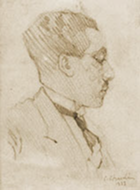
chafik charobim
1894 - 1975
Synopsis
Charobim was the first Egyptian artist to graduate from the Academy of Fine Arts of Rome in 1923. When he returned to Cairo with his degree in painting in 1924, he was honored by King Fouad 1st with a teaching position at the new School of Fine Arts of Cairo. Too engrossed in the world of painting, the free-spirited artist rejected the constraints that went with the appointment, and opted to follow the path of his passion by focusing on painting.
Of all the pioneer Egyptian painters, Charobim was perhaps the richest in his artistic reproductions of nature, with startling detail. As primarily a landscape painter, the prolific artist accented the truth and reality of color in Egyptian scenery, often flooded with light. His paintings praise the beauty of an eternal, romantic and serene Egypt where life was simple and people were carefree. The artist also loved Lebanon, where he would often take his family to spend summer holidays. The sceneries he painted there, depict the magic behind the beauty of Lebanon's mountains, valleys and villages.
Charobim also regularly painted his family, friends, bedouins in the desert and other characters. Besides capturing the feelings of the subject behind the features in his portraits, he excelled in his anatomical draughtmanship and was outstanding in his painting of hands, which many artists avoid.
During his early career, the artist held a number of exhibitions of his works in Europe. Several of Charobim’s paintings were purchased by museums of contemporary art, private collectors and art connoisseurs in France, Great Britain, Italy, Norway and Switzerland. In Egypt, Charobim's works were exhibited at the Friends of the Arts, the Cultural Center for Diplomats, the Union of the French, Belgian and Swiss Universities as well as at the Italo-Egyptian Art Exhibition Center. His works were also exhibited posthumously; at the Society of the Friends of Arts, the Egyptian Art Center, and at Ebdaa Gallery. Some of his works can be viewed today at the Museum of Modern Egyptian Art in Cairo. His paintings were highly praised by numerous Egyptian Ministers of Culture, including Badr El-Din Abou Ghazy and Farouk Hosny, as well as by international art critics such as Miriel, Claude De Rives and Gabahangi. Charobim's works can be found today at the Egyptian Modern Art Museum in Cairo.
[01] Childhood & early life
Chafik Charobim, born on November 4th, 1894, was the first child of Michail Bey Charobim (1861-1918) and Henena Badir (1870-1952), and was followed by four siblings. His father was Chief of the Court of Justice as well as a writer and historian who's most notable work is the history of Egypt in 5 volumes “A Compendium on the Ancient and Modern History of Egypt”.
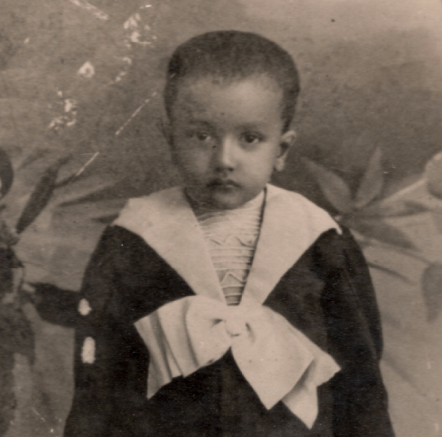
Cairo 1896
Charobim aged 2
In 1900, Charobim's father, was transferred from Cairo to Alexandria, where he rented a small palace in Moharam Bey for the family. The young Charobim attended his primary classes at St. Andre’s School there. The palace with its surrounding gardens left a lasting impression on the 6-year-old who kept the memory of the palm trees and bright colored flowers, and later sketched them from memory. The family stay in Alexandria lasted three years, and on their return to Cairo, he was sent to St. Mary’s School in Garden City. It is then that he began to sketch, with the encouragement of one of his father’s cousins who painted as a hobby.
Charobim’s father had high hopes of his son becoming a doctor and dismissed his art-work as child play. But the passion for art had already taken its hold of the young artist’s dreams. He sketched and drew under the direction of his art teacher, who had quickly recognized Charobim’s talent. When he later attended secondary school at the College de La Salle in Koronfiche, Father Léon, who taught drawing and painting, mentored and guided him in art. Recognizing the young man’s talent, he asked Charobim Bey to send the young man to study painting in Europe. The notion of his oldest son averting recognized academic studies in Egypt, at the time, was out of question for the father. Alternatively he would settle for an engineering or career for his son, instead of a medical one.
Meanwhile, in class, Charobim often sketched portraits of his teachers and classmates, who gladly posed for the aspiring artist. To satisfy his fervor for art, Charobim took painting lessons with several European artists who resided in Egypt at the time, one of whom was Tennyson Call, King George’s portraitist.
[02] Education
Bending to his father’s wishes, he attended the Faculty of Civil Engineering at Fouad the First University (now Cairo University). But his father's death in 1918 changed the course of his life. Already in his third year of school, he dropped his studies and took over the responsibility of managing the family’s land property.
By 1921 having set the ball rolling, he married Marie Ghali and they left for Italy to fulfill his aspiration of obtaining an academic art education. Their son, Ramses was born in 1923 in Rome.
At the Academy of Fine Arts of Rome, and coached by his mentor Professor Umberto Coromaldi (1870-1948), Charobim studied landscape, portraiture, still-life, and the nude. He was influenced by impressionist painters, namely Alfred Sisley, Pierre-August Renoir, Camille Pissarro and Paul Cézanne, but was above all, he was fascinated with the work of Jean-Baptiste-Camille Corot, a pivotal figure in landscape painting, whose vast output simultaneously references the Neo-Classic tradition and anticipates the plein-air innovations of Impressionism. Eventually Charobim developed his own unique style, which cannot be adequately categorized with other artists’.
While in Rome he met and became long-life friends with his compatriot painters Youssef Kamel and Ragheb Ayad as well as with Mohamed Abdel Kouddous, who was studying Dramatic Art at Saint-Cyr, France.
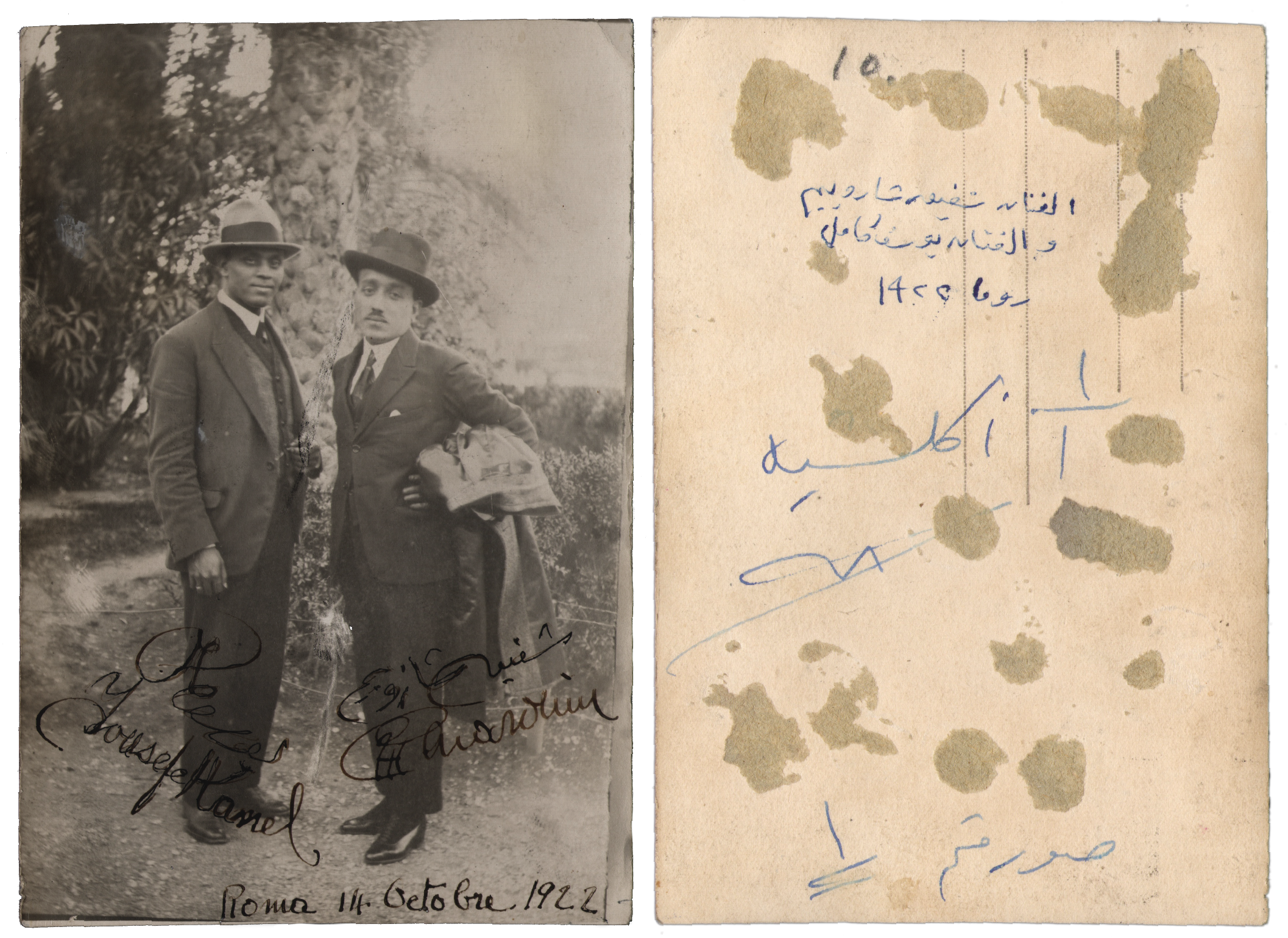
Rome 1922
Charobim and Youssef Kamel
Following his graduation from the Academy of Fine Arts of Rome in 1923, Charobim returned to Cairo with his degree in painting in 1924, and was honored by King Fouad the First with the title of “ Bey” as well as with a teaching position at the emerging School of Fine Arts of Cairo.
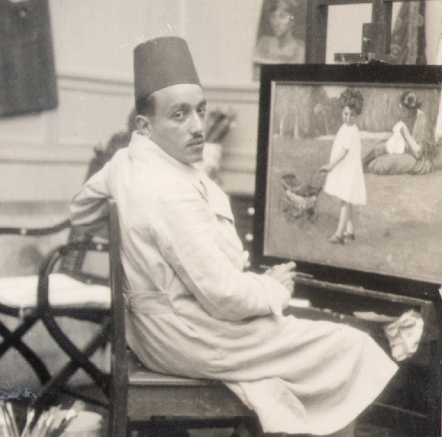
Rome 1924
At his easel
[03] Early Career
During that era when art flourished in Egypt, Charobim,orientalist painter Roger Breval, sculptor Mahmoud Mokhtar, painter Ahmed Sabri and other artists founded "La Chimère". The setting located on the ground floor of a building on Antikhana Street in Cairo’s down town area, served as studios as well as exhibitions space for eminent academic artists. Other than the founding members, artists included Beppi Martin, Mahmoud Said, Mohamed Hassan, Nagy and Youssef Kamel. Roushdi Pacha, president emeritus often visited and bought their works.
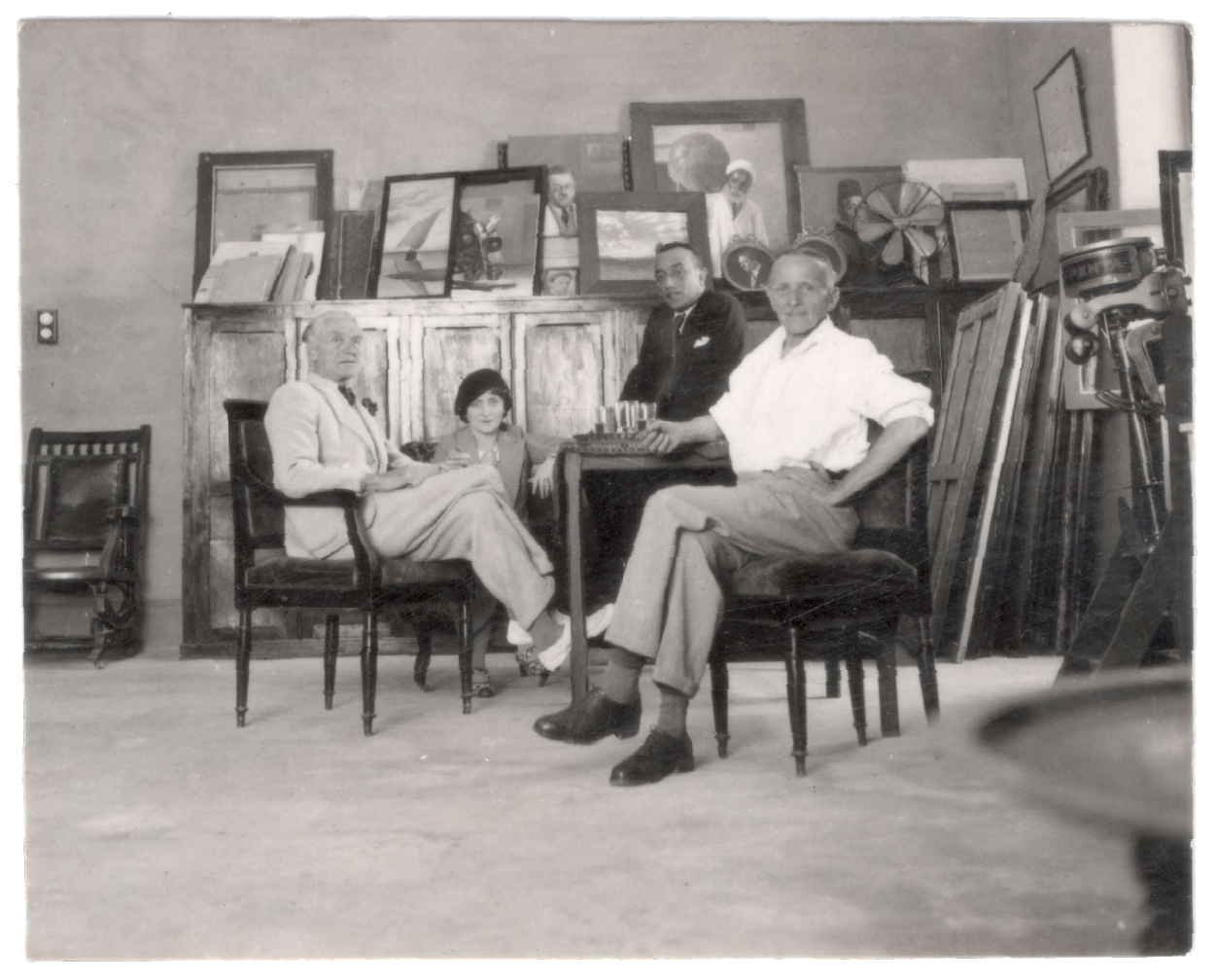
Cairo 1926
La Chimère
In 1923, the Friends of the Arts collective organized their first exhibition, displaying the works of a number of Egyptian painters and sculptors. It was inaugurated by King Fouad I, who bought one of Charobim’s paintings entitled “The Dog”.
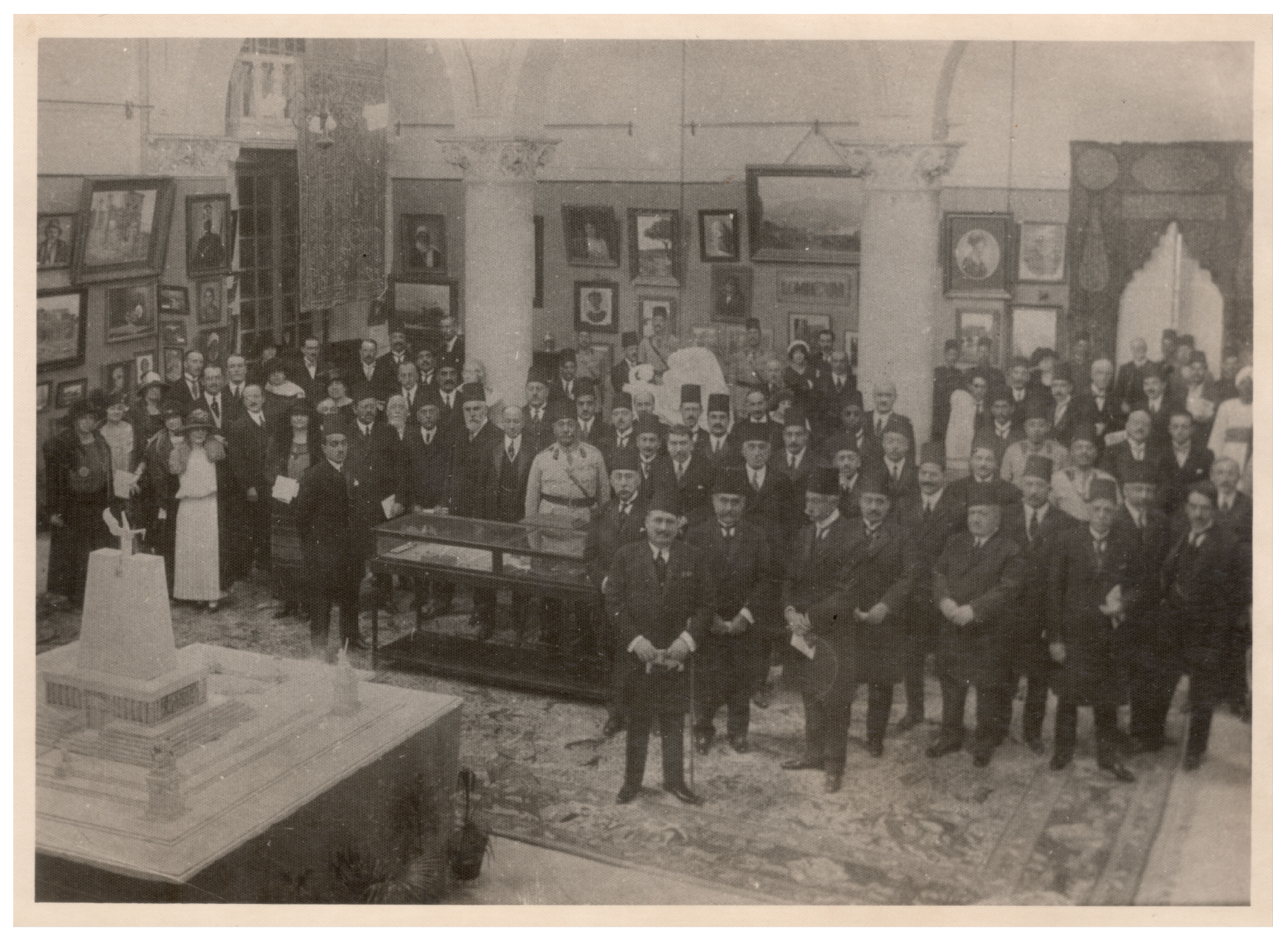
Cairo 1927
Friends of the Arts exhibition – Savoy Hotel
Following a long and painful illness, Charobim’s wife died in 1927 leaving him with the care of their 5-year old child. During that period, the artist’s somber mood was reflected in his limited paintings, mostly of sunsets. He began reading extensively however, and his interests ranged from history, politics and philosophy to animal life, medicine and naturally to art and its history. At the same time, being a deeply sociable man, he kept a close relationship with his extended family, friends and neighbours. One of these neighbours and close friends was El-Sheikh El-Maraghy, head of Al-Azhar at the time.
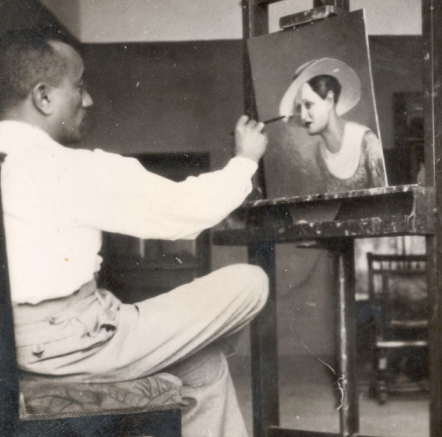
Cairo 1935
At his easel – Helwan
[04] Mid Career
Charobim had both a keen intellect and a wide range of interests. Besides painting, his other fervent passion was hunting. It was through his numerous hunting trips that he became familiar with the varying landscapes, flora and fauna of Egypt. These trips led him and his companions all over Egypt, and all the way to Sudan.
At each new spot, he would seize the opportunity to document scenery, people or animals that caught his eye. He showed a remarkable ability to distill the best from the tradition of landscape and seascape.
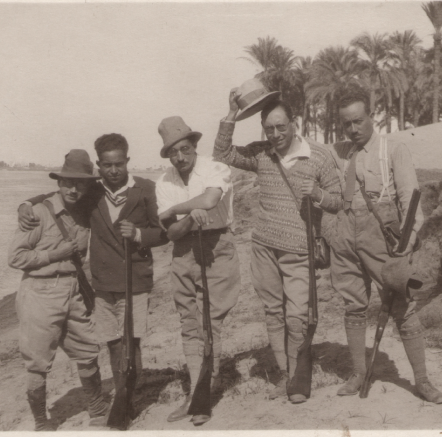
Giza 1930
Hunting trip – Badrashein
Charobim was also a talented pianist and frequently organized musical session at his villa in Helwan, a Cairo suburb. He was also an accomplished equestrian, loved animals and kept in the garden of his villa dogs, cats, a goat, a monkey, geese as well as various other animals and birds, at different times, and his fondness of animals is reflected in many of his works. In 1939 the Egyptian Royal Shooting Club was founded and Charobim was its sixth member. For the rest of his life Charobim regularly participated in the club's activities and shooting competitions and often won trophies in recognition of his shooting proficiency.
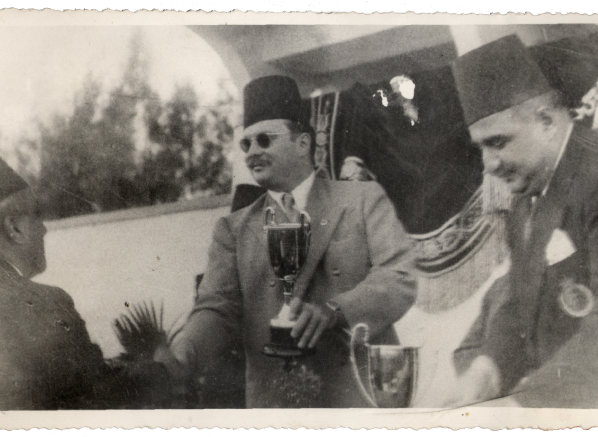
Cairo 1947
Receiving a shooting championship trophy from King Farouk – Shooting Club
[05] Later years
In 1940, a year after his son graduated from university, Charobim volunteered at the Police Academy, where he spent a year. During the same year, he married Marie Greis, the cousin of his late wife.
They had two children; Yehia and Marion. It is during these years that he produced the majority of his work. On a daily basis, he prolifically painted in his studio as well as in various spots around him, scenes from Egyptian everyday life as well as portraits. During the summer months he would take his family to Rosetta, Alexandria or Ras El-Bar. The months spent on Egypt's seashores inspired him to produce compelling epic works of the Mediterranean and its shores where one can just about sense the smell of iodine. On several occasion during the nineteen fifties, the family would spend summers in Lebanon, where life was peaceful, then. Its mountains, valleys and villages provided him with visual material that he drew upon in numerous works.
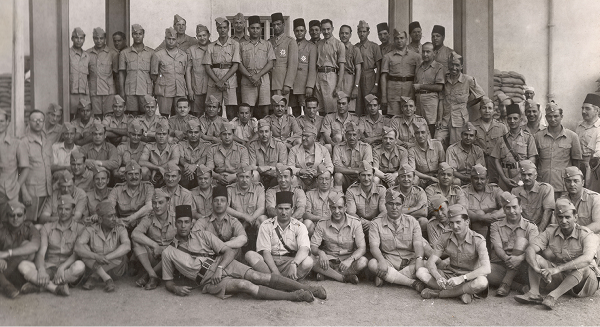
Cairo 1940
At the Police Academy
[06] Style
Charobim's work transmits to the viewer a realistic vision, often imprinted with the pureness of Egyptian landscapes and skies in exquisite colors. He strove to unite the discipline of classical art with the immediacy of impressionism.
His work is notable for its careful reproduction of form, its organic and genuine character, and its consummate craftsmanship. Inclined to conciseness and to simplicity, he excelled in small paintings, masterpieces of moderate dimensions, of limited, meticulous designs and ranges.
For his choice of subjects, drawn from ordinary everyday life, and more specifically for his profound understanding of agriculture coupled with his anatomical craftsmanship, his work is revered as a realistic, yet romantic documentation of twentieth century Egypt. His themes are expressed in colorfully angular, simplified, expressive, and richly inspiring effects.